Pat Barker’s Blow Your House Down, violence against women and Reclaiming the night
When I was in my mid-teens, I visited Leeds with my parents for some forgotten reason. What I remember was the detour we took to a block of flats in a student-dominated area. To the majority of the population, it is an unremarkable housing construction. But to my parents, it played an important role in their shared history: it was their first home after they married in the late seventies, and the first property they had ever owned.
I duly admired the exterior (we couldn’t gain access to the building), and Mum and Dad reminisced about their neighbours (the woman upstairs had hardwood floors and wore stilettos with zealous devotion, the man downstairs had a Scottish terrier called Dunlop, because it was black and bouncy. Unadulterated genius). We got in the car after roughly ten minutes and drove off to wherever we were supposed to be.
It wasn’t until many years later that I realised, that Leeds in the late seventies was under the horrific thrall of the Yorkshire Ripper.
The Yorkshire Ripper, a man named Peter Sutcliffe, terrorised the North of England for over ten years. He assaulted and murdered women, a great many of them sex workers, with tremendous violence, in Leeds, Bradford, Halifax and their environs. Despite an extensive police investigation, he was not apprehended until 1981, over a decade since his first attack. He was eventually convicted of murdering thirteen women and assaulting seven, though it is likely that his true number of victims is even higher.
I mentioned this to my dad, not so long ago. He then told me something I’d never heard before. By 1980 they’d moved back across the Pennines to Manchester. That same year in Leeds, a short distance away from their former flat, near a row of shops that they used to frequent, a young woman, a student at Leeds University, was murdered by the Ripper.
I won’t recount the details of the murder here. But Dad told me it brought the horror and the fear home in a way that endless news reports had never done. A woman, only a few years younger than my Mum, living in the same area. She had been desperately unlucky. Mum, luckier, or else I probably wouldn’t be writing this.
A few months later, the Ripper was arrested at last, and his marauding, his violence and his killing finally ended. Despite five years’ worth of police investigation, it was the sharp instincts of a young police officer that apprehended Peter Sutcliffe and unmasked him.[i] I’ve watched several true crime documentaries about the Yorkshire Ripper, some more sensationalist than others, and certain things always stand out. One is the sheer degree of police bungling. Officers interviewed Sutcliffe nine times over the course of the investigation but failed to realise he was someone of interest. Then there were the infamous tapes sent by someone purporting the be the Yorkshire Ripper, which caused the police to focus on men with a strong Wearside accent and the investigation to be moved away from West Yorkshire.[ii] This was despite multiple voice and profiling experts informing the police that the tapes were almost certainly made by a pretender. The reprehensible hoax possibly delayed Sutcliffe’s arrest and led to the deaths of more women.
But what appals me every time the story of the Yorkshire Ripper is recounted on TV documentaries or in the news is the sheer sickening amount of institutionalised misogyny – and the misogyny perpetrated by and surrounding the Ripper in general. There was a deeply ingrained prejudice in the police, amounting to the idea that the murdered women were “only prostitutes,” and were somehow deserving of their fate. The media was no better. The murders received limited notice and victim-blaming was par for the course. It was only once someone “decent” was killed that the Yorkshire Ripper and the investigation into his crimes began to receive national attention.[iii] Even then, it was widely believed that the Ripper was singling out sex workers and that “good” women were safe, that the Ripper only targeted “bad,” degenerate women. Some football fans even sang chants about the Ripper at games. Nothing like singing about the most prolific serial killer in decades to inspire your team to victory.
A few short years after the Ripper’s arrest and conviction, a writer named Pat Barker published her second book. Barker, though best known these days for her Regeneration trilogy, which focuses on male psychiatric patients during WWI, began her literary career writing, for want of a more accurate, elegant phrase, “kitchen sink dramas.” That is, Pat Barker’s early novels focused on working-class women. Her first novel, Union Street, published in 1982, centred on the lives of seven women, ranging in age from their seventies to their pre-teens, inhabiting the titular Union Street. The novel’s subject matter, which covers rape, abortion and childbirth, was declared by one reviewer to be “far too gynaecological” (I just strained my eyes from rolling them so hard).[iv]
But, undeterred, Barker continued with similar characters and issues in her second book, Blow Your House Down, first published by Virago in 1984. A summary of the novella is as follows: it centres on the lives of a group of sex workers in an unnamed city in the North of England. There’s Brenda, with three kids and no-one to lean on. Audrey, in her forties but with no other means of earning money. Elaine, pregnant and besotted with an abusive arsehole. Jean, young but tough as an old buzzard. Kath, who has nothing left in her life but drink. They have all turned to prostitution for various reasons. But along with the usual trials accompanying sex work (violence, social ostracization, the threat of arrest, STIs) there is a serial killer on the loose, specifically targeting sex workers. (I wonder what the gynecologically repulsed reviewer made of that?) Jean’s lover, Carol, another girl of the streets, has been missing for weeks. And one night, Kath’s luck runs out.
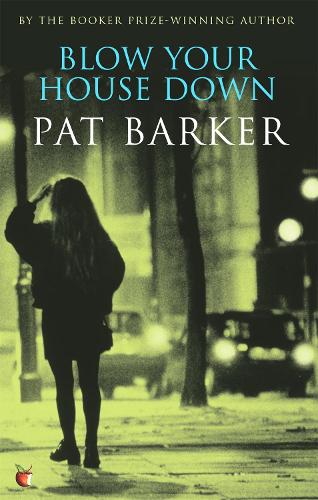
It’s not long after when Carol is found, having suffered the same fate. With the police either uninterested or ineffective, Jean sets out to find the killer and deliver her own brand of rough justice. Whether she succeeds is unclear: Barker offers hints, nothing more. She is too good a writer to offer a neat little revenge fantasy.
The final chapter departs from the perspective of the women we have grown familiar with and introduces an entirely new character, a “respectable” woman who is attacked by an unknown assailant. The chapter details her struggles with her recovery, the impact the attack has on her mental health and her relationships.
Each time I read Blow Your House Down, I marvel anew that it ever got published. While serial killers have always provided fodder for thrillers and police procedurals, Barker’s novella turns away from the investigators and the killer himself (we never even learn his name) and focuses on the women at risk of becoming his victims. These women are people society has pushed onto its lowest rung, and they’re still being kicked to make them let go of the ladder. They’re sex workers, working-class women, single parents. They’re loudmouthed, unapologetic, brash. But despite the cruelties that life has inflicted upon them, these women are unbroken. They are naturally articulate, even poetic. Their language is imaginative and vivid, not merely crude.
And Barker doesn’t romanticise or hypersexualise the women selling sex: this no Pretty Woman or Belle du Jour. Sex, when it is portrayed, is just another job and usually a distasteful one, done in abandoned houses or the backseats of cars after a brief conversation (“how much?” “Fiver. With a rubber.”). Barker writes without sensation, without titillation, and most importantly without patronisation. She empathises; she does not pity.
A novel about working class women engaged in sex work that isn’t a moral fable or skewing towards pornography. How did it find its way into print in the Yuppie Eighties? This was not the sixties, when the working classes had become briefly fashionable in film and literature, when writers such as Jeremy Sandford, Nell Dunn and Barry Hines turned their attention and considerable skill to portraying the lives of those who lived on the breadline, who worked in the mines and the factories, who lived in the “wrong end” of town. The Thatcherite Eighties were all about the pursuit of wealth, the free-market economy and unbridled consumerism. The working classes were not infrequently dismissed as troublemakers out for what they could get (the Miner’s Strike of 1984, one of the longest and most bitter industrial disputes in British history, looms large in our cultural memory with good reason).
The answer? All hail Virago! I’ve written about this feminist publishing house before (see my post on Costa Rica and Kay Boyle) and although they are perhaps best known for rediscovering and republishing women authors who have fallen into obscurity, they also publish a great of contemporary fiction and non-fiction by women and the occasional man. With such controversial subject matter, I think Barker would have had a bitter fight on her hands to get her work printed by any of the more conventional publishing houses. Even so, it took ten years before Union Street was finally published, also by Virago. That novel hacked rather than blazed a trail for Barker’s subsequent book, but the fact that both are still in print after forty years is notable.
Back to the novella itself: Barker takes great pains to humanise these women. Brenda, we learn, grew up in care, got pregnant at age sixteen, and although she marries her boyfriend, it does little good. His family despises her, and Brian, her husband, proves to be appalling with money. When he ups and leaves, he also leaves behind ludicrous amounts of debt. Brenda goes to work in the nearby chicken factory, packaging the freshly slaughtered birds. She leaves her kids with a local childminder, but when the woman turns out to be abusive, Brenda keeps her children at home. This in turn means she is forced to abandon her job. When what little money she has runs out, she begs a friend to watch her children in the evening and goes to stand on a street corner, touting for business.
Kath, already on the game, finds her. It’s the first piece of luck Brenda’s had in months: she realises in retrospect that she would have been thumped and chased away by most women, who wouldn’t want any competition for custom. But Kath mentors Brenda through her first hellish weeks as a sex worker and the women form a close, powerful bond. Kath’s a tough woman: her only softer feelings seem to be for her two sons.
Then, she finds a man. Not just any man, a man she can envision a future with.
Men in Blow Your House Down are bad news. No not all men qualifiers here (with one possible exception… more on this later). Men lead to heartbreak, loss of earnings, loss of independence, getting punched in the face. Kath’s nameless partner is the same. She leaves for four years and when she returns, she’s pregnant, an alcoholic and an almost-ghost. It’s only a matter of time before drink or the devil catches up with her. Against the odds she has a healthy baby girl and in a scene that’s equal parts ludicrous, funny and shocking, goes into labour while she’s with a punter. He shoves her onto the pavement and speeds off, no doubt rehearsing some unlikely story about why he came to be drenched in amniotic fluid to pacify a suspicious wife. “You mean bastard, you could’ve given us a lift!” yells Brenda. You shouldn’t laugh. At the same time, you should. What else can you do?
Kath delights in her daughter, but it doesn’t last. She gets arrested, sent to prison, and loses the children to Social Services, who’ve been buzzing round her like wasps. From a comfortable, middle-class, Daily Mail perusing existence, condemning her would be effortless. Drunken prostitute loses custody of children. Broken Britain and all that. But the reader learns who Kath is, who she was to Brenda, and when Kath is murdered, we see her mourned by the women she worked with and are reminded that she leaves behind three children whose lives will be overshadowed by their mother’s violent death. Perhaps the children being taken into care was for the best. Perhaps Kath was no longer a fit parent. The novella doesn’t go into details about Kath’s family life, making it hard to ascertain (and I’m not qualified to do so in any case). But it doesn’t lessen the pain. As the great Angela Carter, a champion of Barker’s, remarked “if they can’t sympathise with the women you’re creating, then sod their fucking luck.”
This focus on the victims rather than the killer has become a recent trend in several texts dealing with serial killers. I recall that when the documentary Hunting the Yorkshire Ripper was released on Netflix, numerous Google reviewers complained loud and long that the documentary barely featured Sutcliffe, instead concentrating on the women he had killed or assaulted. Likewise, in the 2023 ITV drama The Long Shadow, also about the Yorkshire Ripper murders, we hardly glimpse Sutcliffe for the first two episodes. Dramas and documentaries about serial killers have a nasty habit of centring the murderer, keeping us all in thrall to him (and it’s nearly always a him. Female serial killers are much rarer than male, although some of the most infamous murderers in history were women). But lately, new examinations of cases such as that of Peter Sutcliffe have been turning away from the killer, who has been saturated with attention, and looking at the lives of those murdered and those left behind. In her acclaimed book The Five: The Untold Lives of the Women Killed by Jack the Ripper, Hallie Rubenhold does the same, focusing on the stories of the “Canonical Five,” the five women generally believed to have been killed by the Ripper. The Ripper himself scarcely merits a mention.[v]
Pat Barker does much the same. However, she doesn’t entirely eschew the focus on the killer, and in a risky move, actually switches to his viewpoint/thought processes when he murders Kath. This raises the spectre of complicity with the murderer, which I’ve noted all along is what Barker’s focus on her female characters allows her to avoid. But Barker is nothing if not skilful in her approach. We never learn the murderer’s name. He is anonymous, an unknown. A nobody. “Somebody’s regular,” as the women observe. Although a murderer, he is also a pathetic, sexually inadequate creature. Barker is cutting in her descriptions of his genitalia: “his cock felt small and worm-like… as moist and confiding as a puppy’s nose, and about as much bloody use.” Despite the justifiable fear he inspires, there is nothing strong or remarkable about him. He’s a miserable little specimen.
We don’t glimpse the murderer again… or do we? In a section that breaks with the omniscient narrator, we hear the story in the voice of Jean. One of the most successful of the sex workers, she’s as hard as a diamond with none of the sheen. She gives little away about herself but she’s no stranger to cruelty and violence. The best thing in her life is – was – her lover, Carol. But when the book opens, Carol is missing and as I’ve already related, she’s eventually found murdered. Jean sets out to find her killer and enact vengeance. Someone dies at her hands… the right someone? Perhaps. But even his possible death isn’t really about him. To paraphrase a song lyric, he’s so vain, he’d probably think this book was about him. But it isn’t. It’s about Jean, about Carol, about the women he’s killed.
The final segment of the book breaks with the women we’ve come to know and introduces an entirely new character. Maggie is a “respectable” woman. That is, she is married (and comparatively happily, a rarity in the novel), she works in the chicken factory and is implied to be middle-aged, having had children who are now grown up. She’s no woman of the streets. On her way home from work one night, she takes a shortcut down an alley. For no apparent reason, she is violently attacked. Although the attack isn’t a sexual one, it’s sudden, brutal and anonymous – her assailant is never caught.
Typically, I object to switching narrators halfway through a novel, especially if the new narrator is someone the reader is unfamiliar with. Hekla’s Children by James Brogden for instance, tries this, switching from the perspective of a teacher to (spoiler alert) that of a pupil of his who went missing years prior. This was an imaginative novel and the change in perspective was not gratuitous: it was necessary for the plot. It also led to a surprise denouement that I found very satisfying. But from a narrative perspective, I didn’t like it. For better or worse I’d gotten to know the teacher, gotten invested in his journey and then I was forced to go along with a girl who I’d only glimpsed briefly and whose existence I’d almost forgotten by that point. With only a third of the book left to go and other, more established characters to compete with, her story struggled to get going. And then she doesn’t even get the last word in the novel (for some reason we get her dad, who we’ve seen even less of).
But Maggie’s story, although brief, doesn’t feel incomplete. Although she’s not a sex worker, she’s a working-class woman who lives a stone’s throw away from the viaduct where they tout for custom. She lives, metaphorically (and possibly literally) next door to Brenda, Audrey, Jean and Kath. We know women like her, even if we don’t know her. It’s a clever stroke: we don’t need Maggie’s full backstory. The novel allows us to fill in the blanks.
It also allows us to empathise with her long and difficult recovery. The attack itself is over in seconds, but its effects on Maggie (and her loved ones) are profound and long-lasting. Although Maggie’s physical injuries heal, her mental recovery takes far longer and isn’t resolved by the close of the book. Her husband is patient but doesn’t truly understand Maggie’s trauma.
So, why introduce Maggie at all? My own personal theory is that Barker is demonstrating that violence is something that threatens all women. For years, women were told to keep themselves safe. Don’t get drunk, don’t go out alone, don’t go out after 10 pm, stick to well-lit areas, don’t leave your drink unattended, make sure you have extra money for cab fare, carry your keys in your clenched fist, ready to strike at someone… and those are just the precautions I came up with without even truly thinking about it. We have a reprehensible tendency as a society to blame women for the violence visited upon them. If she hadn’t spoken back/gone out late/gotten drunk/been nicer, she might have avoided being attacked, is the (misogynistic) assumption.
It’s utter nonsense. It’s clear that there’s nothing Maggie could or should have done differently. She took a shortcut – so what? Thousands will have done the same without coming to grief. Maggie just had the terrible misfortune to do so at the precise moment someone was out there, looking for a woman to hurt. But even she’s confronted by the assumption that somehow, she was “asking for it.” She recounts her interview by police, in which they assumed she was a sex worker despite no evidence to support this. Of course, Maggie had to be a sex worker. Why else would she have been assaulted? That sort of thing doesn’t happen to “good” women. Except that it does.
Barker concludes the novel on a strange note: thousands of birds, flying above the city. Starlings, searching for a place to roost. A flock of starlings is known by the wonderful term, a murmuration. If you’ve never seen the stupendous sight of a murmuration settling down for the night, then search for “murmuration” on YouTube. It’ll be more than worth a few minutes of your time. Starlings are noisy birds, often congregating in large flocks, and are mostly urban dwellers these days. They are small birds, plain brown upon first inspection, but the closer you look, the more you can see.
I wish more had changed in society since Barker first wrote her novel. For some conception of just how sexist the eighties were, Susan Faludi’s Backlash: The Undeclared War Against Women is a little dated by now but still well worth a read (and her central arguments are still depressingly relevant). Faludi basically opines that whenever women make substantial gains in terms of rights, public visibility, inroads into previously masculine fields of employment, then there is a subsequent “backlash” designed to force them back into a subordinate role, a private sphere. For instance, after Second Wave feminism in the seventies, the eighties were all about a “man shortage” and an “infertility epidemic” (neither borne out by statistics). After the Girl Power of the nineties, the media of the noughties was consumed by unbridled misogyny and the vicious shaming of women in the public eye.
Well, the times they are (very slowly) changing again. In recent years, the #MeToo movement, the work of activists like Laura Bates and the Everyday Sexism Project, the Fawcett Society, has begun to change the narrative. More and more ugly stuff is being uncovered. And the onus is gradually shifting towards men, to rein themselves in. To act like decent human beings. Unhappily, this is being mirrored by the rise of incel culture (the chilling effects of which are portrayed in the TV drama Adolescence), burgeoning online misogyny and the continued sexism of institutions such as the Metropolitan Police (the police force in its entirety, in fact). We’ve come a long way, we still have such a long way to go.
Normally, I’d sign off here by saying “don’t go out alone.” But after writing this post that just feels… well, wrong. So, I’ll say take care, everyone.
Reclaim the night.
References
[ii] Wearside Jack – Wikipedia
[iii] Murder of Jayne MacDonald – Wikipedia
[iv] Dispatches from the front | Pat Barker | The Guardian
[v] Although Jack the Ripper’s victims have been assumed to be sex workers, interestingly, in at least three cases out of the five Rubenhold finds no hard evidence that the women ever engaged in prostitution. Merely the act of sleeping out in the street was usually enough to condemn a woman as a sex worker in Victorian times, and the assumption that all the Ripper’s victims were sex workers has only been questioned very recently.


Leave a Reply