It was March 2020 and although I was merrily unaware of it, the world was about to change irrevocably. But before words like Covid, lockdown, quarantine, isolation, sanitiser became part of our everyday lexicon, before the UK government finally stirred its stumps and took reluctant action, and before society underwent its greatest upheaval in a generation, I was in San Jose, Costa Rica with my husband. It was the final day of our holiday, and we were wandering around the city, exploring as much as we could before heading to the airport for our evening flight to Schiphol Airport in Holland.
A year and a half earlier we’d purchased our first house. We’d been discussing the possibility of children (or maybe just starting with a cat). Obtaining a car. Redecorating. But before all that adulting, we’d decided to have one last incredible holiday. One last opportunity to go off gallivanting and see a little more of the world. On our previous ‘holiday of a lifetime,’ our honeymoon, we’d gone to Sri Lanka and Singapore. We decided to head in the opposite direction for this voyage, and largely because my sister had been a couple of years prior and had an amazing time, we settled on Costa Rica.
Have you ever been to Costa Rica? It’s becoming an increasingly popular destination for travellers from the UK. It’s an eco-tourist’s dream: swathes of rainforest, beautiful tropical beaches, dizzying mountain ranges and a truly insane number of bird species and animals to espy. My husband and I were fortunate to get places on a tour with Grace, a very knowledgeable and welcoming guide who did a fantastic job taking us from San Jose to Arenal to Monteverde to Quepos and back again. We did ziplining (I think my adrenal glands exploded), drank cocktails in pools formed from volcanic hot springs, had hummingbirds perch on our hands in cool, clouded rainforest, sunbathed by the Pacific (probably the saltiest ocean I’ve ever swum in).
There was more, loads more, but this post isn’t about our journey through Costa Rica (besides, it would probably need about eight posts to cover most of it). It’s about the end of said journey. We were strolling around San Jose, no destination in mind, when I was diverted by a display of books – books in the English language. Irresistible. I leapt in. My husband, who had long ago learned the futility of trying to drag me out of bookshops, heaved a sigh and followed.
I had chanced upon Mora Books, a small but supremely well-stocked second-hand bookshop. The books were printed in English, Spanish, French, German and their cracked spines, bent pages and battered covers told innumerable silent stories of previous readers. I wandered through the shelves, the concrete floor cool, the Central American sun button bright, removing the need for artificial light. All the colours on the spectrum were there, but, acting on a hunch, I was searching for a very specific shade of green.
Dependable is a word that doesn’t often find itself written alongside Virago. The former suggests reliability, habit, predictability. The latter delineates an angry, violent, shrewish woman, or in this particular context, the well-known publishing house that prints women’s writing and books on feminist topics (they chose the name Virago with purpose). The green spines that became synonymous with their publisher belong to the Virago Modern Classics series, the first of which, Frost in May by Antonia White, was reprinted in 1978. The aim of this series was to allow readers to discover (or rediscover) forgotten or neglected works of literature by women authors. I have a small collection that I treasure for various reasons – including a copy of the very first, Frost in May, thanks to my marvellous Mum and a hospital book sale.
For years, the covers of the Modern Classics were formatted in the same way: a picture and title on the front, and the spine and back cover coloured dark green with white text outlining the title and blurb. They’ve undergone a redesign since (I have several of those, too) but you can nearly always find an original Virago green spine in any second-hand bookshop you care to frequent. They’re very dependable.
To return to San Jose… I was determined to buy a book. Although we’d collected plenty of souvenirs prior to our final day, I wanted to buy a book in San Jose, so that whenever I gazed at it, upon my bookshelf, I would remember where and when I bought it. There’s a rather tattered copy of Simone de Beauvoir’s All Men Are Mortal (another Virago publication) that I bought in Shakespeare’s in Paris, a tiny little volume about ley lines that I got at Word on the Water in London, a copy of Lisbon Poets in Portuguese and English that I found in Livraria Bertrand in… well, Lisbon. Perhaps not the most well-thumbed or well-recalled books in my substantial collection (except for de Beauvoir) but they’re there. And when I notice them, I remember, I was there too.
So, to return yet again to San Jose, I had a hunch there would be a green spine somewhere in Mora Books, and there was (otherwise this post would be somewhat anticlimactic). Year Before Last by Kay Boyle. I’d never heard of the novel or the author prior, but bought it, nonetheless.
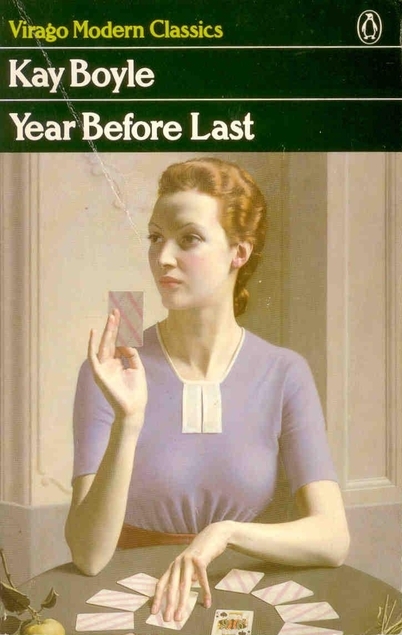
Kay Boyle was an American writer, editor and political activist whose work made a significant contribution to Modernist Literature. In her later life, she was blacklisted from most major American magazines and lost her position as foreign correspondent for The New Yorker because of McCarthyism, although she was eventually cleared of being a national security risk. She also opposed American involvement in the Vietnam War and taught at various universities. There’s a heck of lot more to her life than the few details I’ve given here, but if I go into too much detail then Godot will turn up before I’ve finished. Long story short, Boyle led an adventurous and exciting life and was a prolific author of novels and short stories. The more I learn about her, the more I am convinced she has been unjustly neglected, possibly because of the lingering effects of McCarthyism, so major commendations to Virago for republishing her books. One last bit of trivia that delighted me when I learned it: she had a daughter called Apple-Joan (sorry, Gwyneth, someone else got there first).
Year Before Last is a semi-autobiographical novel. That is, it is based on the events of Boyle’s own life, all of which took place before she turned thirty. It follows the lives of Hannah and Martin, the latter a writer and editor of an avant-garde magazine. Hannah has left her husband to live with the brilliant Martin, but their union is far from straightforward. Martin’s health is deteriorating, they are always in financial peril, and Martin’s possessive and obsessive Aunt Eve, who funded his magazine, has stopped providing money because she is jealous of his new love, but is always more than willing to bring the drama.
Year Before Last is a slow-moving, almost meandering novel that isn’t plotted in any conventional sense: no mystery to be solved, no villain to be overcome (Eve is too complex a character and her quasi-sexual relationship with Martin too multifaceted for her to be a conventional villain) no end-of-novel climax. Honestly, although it was an interesting read, it’s not one of my favourite books ever, or even one of my second-tier favourites. I took The Dud Avocado by Elaine Dundy, another Virago green spine, to Costa Rica and vastly preferred it (it helps that Dundy’s novel is flipping hilarious). But whenever I look at Year Before Last, I remember where and when I bought it, and for that reason it will always have a home on my bookshelf. It saw me through the plane journey home, the start of lockdown and every so often I reread a few pages. Read this out loud, if you will:
“Layer by layer as they climbed the land changed for them and the clear air poured in upon their faces. Behind them hung the dogs’ warm muzzles, their noses dewed and eager and wavering with spring. The trails of wild things escaping or scents they crossed, sent the dogs whistling with grief and impatience against the windows of the car.”
How like our journey through Costa Rica (apart from the dogs). It’s been three years before the last since we were there, but for me Year Before Last will always summon Costa Rica, that final day in San Jose and a remarkable second hand bookshop for me and as such is worth far more than the few dollars I paid for it.
What about you, dear reader? Do you cherish books because of where and when you bought them, because of who gave them to you, because of what they represent outside of the stories they tell? Let me know if so inclined, and until then, happy reading.
Don’t go out alone.
 DeMonsterAting
Leave a comment